
Fill out the form to get access to the resource
"Are we building the right thing?" may seem like a very uncomfortable question. It sounds so simple, yet it rarely is.
We call it the hero of every story.
What Happens in Discovery?
Learn Who We're Actually Building For
User research isn't about asking people what they want. It's about understanding what they actually do — their behaviors, their frustrations, the workarounds they've invented because the current solution doesn't quite work.
We conduct interviews, map real usage patterns, and cut through the assumptions your team has built up over time.You need to understand the user deeply, or else, nothing in the product will be able to compensate for that gap.
Discover What the Business Actually Needs
There's often a gap between what a company says it wants and what the business model actually requires. Discovery maps ambition against reality: What are the technical constraints? What systems need to be integrated? What's the timeline, and what does that timeline make impossible?
Surfacing these constraints early is the only way to make decisions that hold up.
Remind What the Market and the Data Are Already Telling You
Before we form opinions, we look at what's already true. Analytics, user flows, conversion data, support tickets, market behavior, trends, competitors. It just needs someone willing to read it honestly.
This is where assumptions get validated. A product team might believe they have a marketing problem when the data shows a checkout flow problem. Discovery is how you find out.
Find Out Everything Imaginable About Your Users
This is where the work gets deep. We run extended workshops to build out user personas, empathy maps, and full user journeys, as live tools that the whole team uses to make decisions.
A persona is a portrait: what this person is trying to accomplish, what's standing in their way, what they say versus what they actually do. An empathy map goes further. It captures what users think, feel, see, and hear in the context where your product needs to work. A user journey maps the entire arc of their experience, from the moment they first encounter your product to the moment they either become loyal or leave.
Together, these artifacts answer a question most teams never formally ask: What does it actually feel like to be our user? When you can answer that, every feature decision gets easier.
How Users Will Move Through the Product and What That Tells Us About Features
Once we understand the user, we can map their journey through the product. This is where flow mapping and early wireframing begin. It is like moving from the abstract to the concrete.
We visualize how a real person moves from first touch to core action: where they hesitate, where they drop off, where a small moment of friction quietly kills a conversion.
This process does something more important than produce deliverables: it forces the entire team to think about features as a system rather than a list. Features that seemed equally important in a spreadsheet reveal very different weights when you trace them through a user's actual journey. Some are sine qua non. Some are nice-to-haves. Some turn out to be solving a problem that doesn't exist.
Prioritise What Gets Built, In What Order, and What It Will Take
By the time we've mapped the user and their journey through the product, we have everything we need to build a feature architecture. This is a coherent, prioritized system that tells us not just what to build, but when and why in that order.
Features are staged by relevance, logical dependency, and business impact. The MVP becomes a real definition of what the minimum set of things this product needs to do to be genuinely valuable to a real user.
From this architecture, we can give you something most agencies can't: a confident cost estimate and a realistic delivery timeline. It takes the guessing out of the story and moves us into possible futures.
The broader product roadmap also takes shape here: features staged across phases, each phase building logically on the last, each milestone meaningful rather than arbitrary. Everyone can see the full arc and understand where they're going, even if they're only building the first chapter right now.
What This Looks Like in Practice
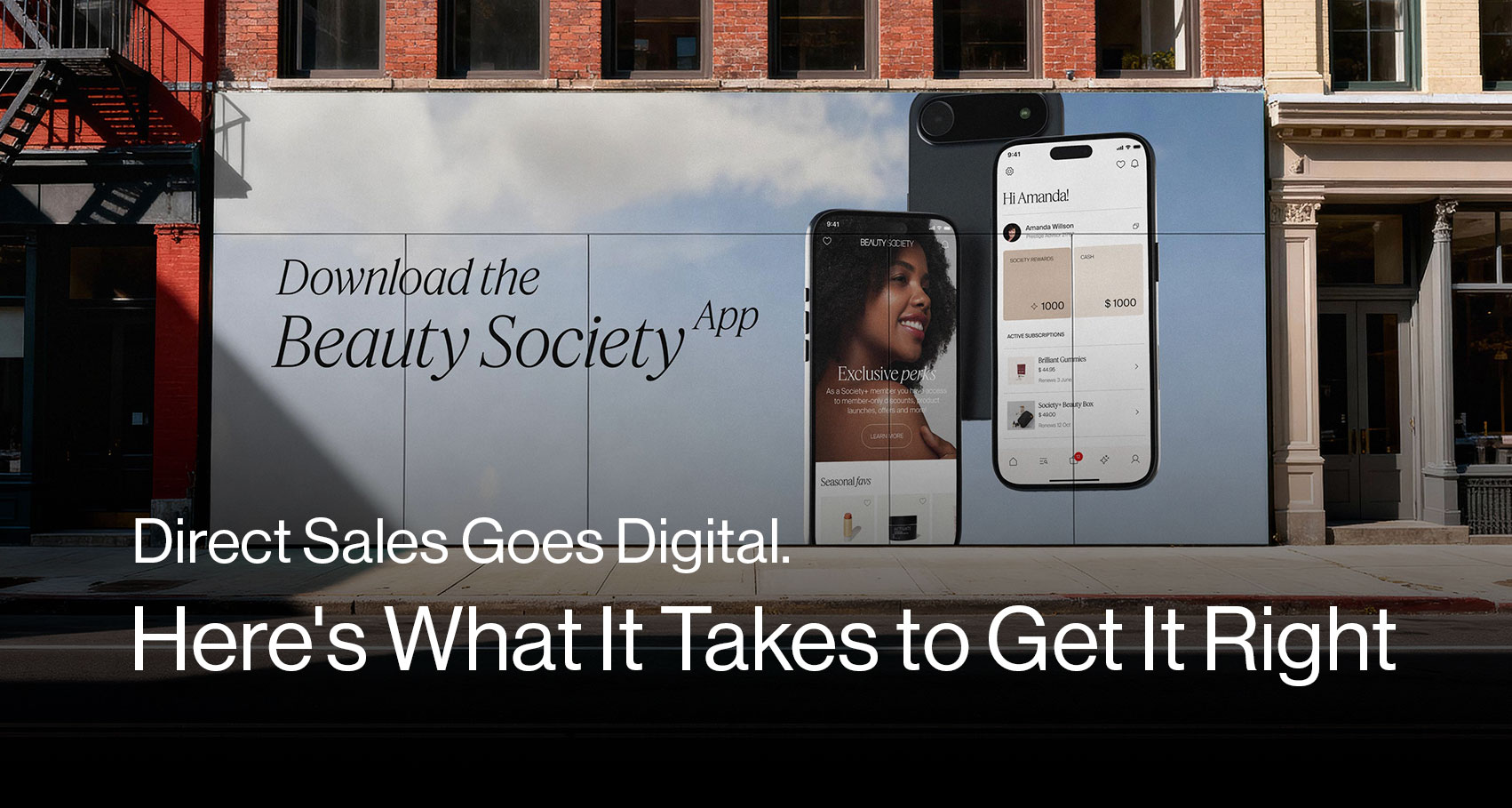
Before Beauty Society launched their new platform, they had a vision: stay at the forefront of beauty and wellness in the digital age, give their advisors better tools, and build an experience worthy of the brand they were becoming.
Before we touched a color palette or wrote a single component, we spent weeks asking questions.
What do advisors actually struggle with in their daily workflow? Where does the current checkout process break down? What would make a customer trust an AI-powered skin recommendation? How does someone actually want to shop for beauty — on their terms, on their timeline?
Those questions shaped everything that came after: an AI-powered skin analysis tool, a virtual try-on experience, a mobile checkout rebuilt around real advisor workflows, and a brand identity that finally matched the product underneath it.
The result:
→ 15,000 app downloads in the first week
→ 52% cart-to-order conversion rate
→ 5.0 App Store rating.
And advisors who actually wanted to use the product.
None of that would have been possible if we'd started with solutions instead of understanding.
What You Walk Away With
At the end of a Discovery Phase, you walk away with a complete execution dossier: user personas, empathy maps, and validated user journeys; wireframes and user flows; a feature architecture with staged priorities; a realistic MVP definition; a cost estimate and delivery timeline you can actually trust; and a long-range product roadmap that everyone on the team has helped shape.
You walk away with a foundation.
The Cost of Skipping It
Poor or skipped discovery accounts for 42% of startup failures. It's not a number that surprises us — we've seen it play out in expensive rewrites, misaligned teams, features nobody uses, and platforms that can't scale in the direction the business actually needs to go.
A solid Discovery Phase reduces overall project costs by 30–50%, cuts time-to-market by 20–30%, and decreases major scope changes by 80–90%. These aren't theoretical benefits. They're the practical result of making better decisions earlier, when changing course is still cheap.
The best code is the code you never have to rewrite.
Discovery Isn't Magic. It's Just the Right Questions.
There's nothing mysterious about what we do in Discovery. It's interviews, workshops, data analysis, flow mapping, lots and lots of research and honest conversations about constraints. The reason it feels like magic is simpler than that: it eliminates guesswork. And guesswork, at scale, is extraordinarily expensive.
Shift Studio offers a $10K Discovery Phase for selected companies. Our team reviews every submission within 24–48 hours and will tell you honestly whether we think we're the right fit. If selected, we'll align on your goals, constraints, and what success actually looks like — then kick off a full Discovery: architecture, strategy, user research, roadmap, prototypes, the complete picture.